Archbishop Desmond Tutu Biography: Early Life, Age, Career, Personal Life and Date of Death

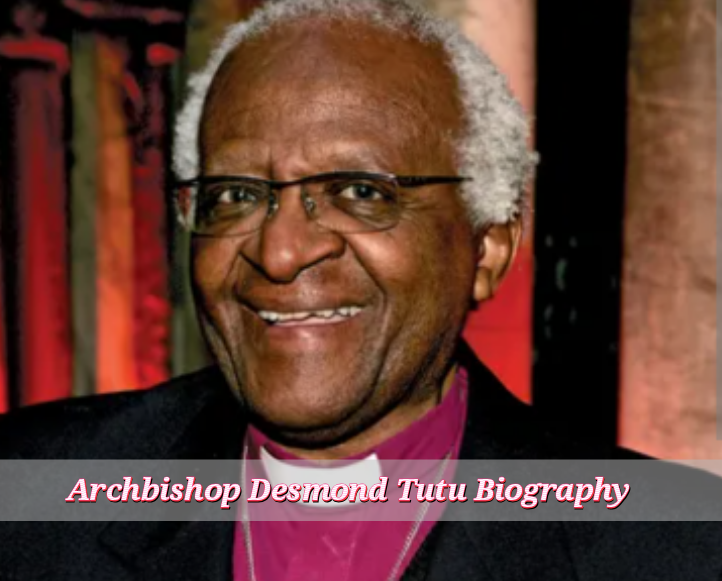
Archbishop Desmond Tutu Biography
Archbishop Desmond Tutu was one of the most respected figures in modern history. Born in South Africa, he became a powerful voice against unfair laws known as apartheid. Apartheid was a system that separated people by race and gave more rights to white people while limiting Black people, Coloured people, and others.
Tutu used his role as an Anglican church leader to speak out for equality. He believed in non-violent change and encouraged the world to put pressure on South Africa through boycotts and sanctions. In 1984, he won the Nobel Peace Prize for his work as a unifying leader in the peaceful fight against apartheid.
After apartheid ended, Tutu led the Truth and Reconciliation Commission. This group helped South Africans face the painful past by listening to stories of harm and offering forgiveness instead of revenge. His ideas came from ubuntu, an African belief that says “I am because we are,” meaning people are connected and must care for each other.
Tutu was warm, funny, and brave. He spoke plainly about right and wrong, even when it was risky. He lived from October 7, 1931, to December 26, 2021. His life shows how one person can help heal a nation and inspire the world.
Archbishop Desmond Tutu Early Life and Family Background
Desmond Mpilo Tutu was born on October 7, 1931, in Klerksdorp, a small town in the Transvaal region of South Africa (now part of North West Province). His family had mixed Xhosa and Motswana roots. They lived in poverty under the strict rules of racial separation that later became apartheid.
His father, Zachariah Zelilo Tutu, was a school principal and teacher. He was strict but cared deeply about education. His mother, Allen Dorothea Mavoertsek Mathlare, worked as a domestic helper. She was kind and strong, and Desmond often said she taught him compassion.
As a child, Desmond faced health problems. He had polio at a young age, which left one hand weaker. Later, he got tuberculosis and spent time in a hospital. These experiences made him value kindness from doctors and nurses.
The family moved to Johannesburg when he was about 12. There, he saw more clearly how apartheid affected daily life. Black people had fewer chances for good schools and jobs.
In 1955, Desmond married Nomalizo Leah Shenxane on July 2. Leah was his student when he taught briefly. They had four children: Trevor Thamsanqa, Theresa Thandeka, Naomi Nontombi, and Mpho Andrea. The children went to school in Swaziland (now Eswatini) at Waterford Kamhlaba to escape poor education options in South Africa under apartheid laws.
Leah supported Desmond’s work and fought for better rights for domestic workers. They stayed married for over 66 years until his death. They had grandchildren and built a close family despite busy public lives.
Archbishop Desmond Tutu Education
Desmond Tutu started his schooling in mission schools where his father taught. These schools were run by churches and gave basic learning to Black children.
He trained to become a teacher at Pretoria Bantu Normal College and later at Johannesburg Bantu High School. He earned his teaching qualification and began teaching in 1954.
But in 1953, the government passed the Bantu Education Act. This law made schools for Black children worse on purpose to keep them in low-level jobs. Tutu hated this and quit teaching in protest around 1957.
He then turned to the church. He studied theology and was ordained as an Anglican priest in 1960 after training at St Peter’s Theological College.
To gain more knowledge, Tutu went to London. At King’s College London, he earned a Bachelor of Arts in divinity and later a Master of Theology. Living in England from 1962 to 1966 helped him see life without apartheid’s strict rules. He returned to South Africa with new ideas about faith and justice.
His education mixed theology with real-world issues like liberation theology, which focuses on freeing the poor and oppressed.
Archbishop Desmond Tutu Career
Desmond Tutu’s career began in the church but grew into global activism.
After ordination in 1960, he served as a curate and lecturer. In 1975, he became the first Black Dean of Johannesburg at St Mary’s Cathedral.
From 1978 to 1985, he was General Secretary of the South African Council of Churches. In this role, he led protests against apartheid. He called for economic sanctions and spoke at funerals of activists killed by the government.
In 1984, he won the Nobel Peace Prize. The Nobel Committee praised him as a unifying leader in the non-violent campaign against apartheid.
In 1985, he became the first Black Bishop of Johannesburg. In 1986, he was chosen as the first Black Archbishop of Cape Town, leading the Anglican Church in Southern Africa.
He met world leaders and pushed for change. He worked with Nelson Mandela after Mandela’s release from prison in 1990.
After apartheid ended in 1994, President Nelson Mandela asked Tutu to chair the Truth and Reconciliation Commission from 1996 to 1998. The commission heard stories from victims and perpetrators of human rights abuses between 1960 and 1994. It offered amnesty to those who told the full truth and helped victims get support. Tutu used ubuntu to guide the process toward healing and forgiveness.
After retiring as Archbishop in 1996, Tutu continued speaking on issues like HIV/AIDS, climate change, peace in places like Darfur, and rights for LGBTQ people. He co-founded The Elders group in 2007 with other world leaders to promote peace.
He received many honors, including over 100 honorary degrees and awards like the Presidential Medal of Freedom in 2009.
Archbishop Desmond Tutu Personal Life
Desmond Tutu was a family man who loved simple things. He enjoyed cricket, reading the Bible daily, and listening to classical music. He was known for his laugh and sense of humor, even in hard times.
His faith was central. He prayed often and fasted regularly. He believed God called him to fight injustice.
Health challenges marked his later years. He was diagnosed with prostate cancer in 1997 and had treatments over time.
Tutu stayed humble. He lived in a modest home in Cape Town with Leah. He valued time with family and friends.
He passed away peacefully on December 26, 2021, in Cape Town at age 90 due to cancer-related issues. His state funeral was held at St George’s Cathedral. Leaders from around the world honored him.
Leah Tutu continued living in Cape Town after his death. The family keeps his legacy alive through foundations.
Conclusion
Archbishop Desmond Tutu left a lasting mark on South Africa and the world. He showed that peace and truth can overcome hate and division. His fight against apartheid helped end a cruel system. His work on the Truth and Reconciliation Commission gave hope for healing after pain.
Tutu taught that everyone is connected through ubuntu. He reminded people to stand against wrong, even if it costs something. His life encourages us to choose forgiveness, justice, and kindness.
Today, his words and actions inspire those fighting inequality, climate harm, and unfair treatment. Desmond Tutu proved one voice can change history when guided by love and courage.
FAQs
Who is Desmond Tutu best known for?
He is best known for leading the peaceful fight against apartheid in South Africa and winning the Nobel Peace Prize in 1984.
Why did Desmond Tutu win the Nobel Peace Prize?
He won it in 1984 for his role as a unifying leader in the non-violent campaign to end apartheid.
What was Desmond Tutu’s role in ending apartheid?
He spoke out boldly, led church protests, called for international sanctions, and kept hope alive during dark times.
What religion was Desmond Tutu?
He was an Anglican Christian and served as a priest, bishop, and archbishop in the Anglican Church of Southern Africa.
Is Desmond Tutu still alive?
No, he passed away on December 26, 2021, in Cape Town at age 90.
What did Desmond Tutu do for human rights?
He fought racial injustice, chaired the Truth and Reconciliation Commission for healing, supported LGBTQ rights, opposed wars, and worked on global issues like AIDS and climate change.